English| EUR
Suggested for you
More currencies
Book Now
Open today · 09:30 – 19:00

Real Alcázar Guided Tour

Real Alcázar Guided Tour — Reserved Entry & Expert-Led Visits

Mudéjar arches above still water, cedar ceilings below.

212K+ travelers chose this
Free Cancellation
Right now: Moderate — summer peak season Midday heat is intense in late July; carry water and expect security lines near opening
1.5-2 hours recommended
1 Languages
Up to 20 people
Free Cancellation
Free cancellation Instant confirmation Mobile voucher Skip-the-line Verified partner
913 AD
Original fortress built
Umayyad Caliphate era
7 ha
Garden size
Fountains, patios, peacocks
1987
UNESCO listing year
Part of Seville ensemble
2.2M+
Annual visitors
Recorded in 2025
Choose your ticket

Ticket options at a glance

Compare fares, pick the fit — all bookings are mobile-voucher and eligible for free cancellation where shown.

Seville: Priority Access Cathedral, Giralda & Alcázar Tour 3 hr
Skip-the-line

Seville: Priority Access Cathedral, Giralda & Alcázar Tour

4.8 (10838)
€53
  • Priority access
  • Skip the queue
  • Mobile voucher
  • Free cancellation
Book this ticket
Small-Group Guided Tour of the Royal Alcázar of Seville 2 hr
Guided Experience

Small-Group Guided Tour of the Royal Alcázar of Seville

5 (728)
€50
  • Expert local guide
  • Small group
  • Skip-the-line access
Book this ticket

Is it worth it?

Worth it for first-time visitors

For 15.5 EUR general admission, a real alcazar guided tour buys you the full ground floor and the gardens, which is where most of the Mudéjar tilework, the Patio de las Doncellas, and the shaded orange courtyards actually live. Weigh that against the gaps: the upper Royal Apartments cost extra and sell out, and signage is sparse, so unguided visitors miss half the context on this UNESCO World Heritage palace. That is exactly where a Seville Alcazar tour earns its keep, turning bare rooms into a legible story of Christian and Islamic Sevilla landmarks. Skip-the-line versions also spare you the ticket queue in summer heat. It pays off for anyone visiting once who wants the history explained; solo wanderers happy with an audio guide can save the guide fee and simply buy standard tickets.

What makes it worth it

  • Ground floor and gardens both included in fee
  • Guide fills gaps left by sparse signage
  • Skip-the-line options avoid summer ticket queues
  • Context turns bare rooms into real history
  • Strong value for single-visit first-timers

Keep in mind

  • Upper Royal Apartments cost extra, sell out
  • Signage sparse if you go unguided
  • Guided tour tickets add cost over admission
  • Midday groups crowd the popular patios

Bottom line: For a first visit, the real alcazar guided tour tour is worth the modest fee; repeat or budget visitors can manage with standard tickets and an audio guide.

Head to head

Real Alcazar Guided Tour vs the Alhambra: Which Palace Should You Choose?

If you're deciding between a real alcazar guided tour and Granada's hilltop rival, the choice comes down to convenience versus scale: the Alcázar sits inside Seville's old town and rarely sells out, while the Alhambra demands months of planning. Most first-time Andalusia visitors booking a Seville palace tour do both, but if forced to pick one, the Alcázar wins on ease and intimacy.

Top pick
Real Alcázar (Seville)
Alhambra (Granada)
Setting and city context Hilltop above Granada, forested plateau
Architectural style Nasrid Islamic palaces, Alcazaba fortress
Size and pacing 35-acre walled complex, more walking
Price per adult Around 22 EUR general admission
Booking difficulty Sells out weeks to months ahead
Best paired with Generalife Gardens, Albaicín quarter

Verdict: Choose the Alcázar for an intimate, easy-to-book skip-the-line Seville landmarks experience close to your hotel, and the Alhambra when you have the lead time to plan around its stricter, larger-scale Nasrid complex.

Featured Experiences

Popular tours & activities

Hand-picked experiences loved by thousands of travelers

Recommended Experience

Powered by GetYourGuide

Another traveler favorite

Powered by GetYourGuide
Seville: Royal Alcázar Small-Group Premium Tour 1.5 hours Free Cancellation

Seville: Royal Alcázar Small-Group Premium Tour

Experience the majesty of the Royal Alcázar on a personalized, intimate 1.5-hour tour limited to 15 guests.

4.7
FromFrom €49.9
See details
Your journey

Step-by-step — what your day looks like

1

Security and entry

Pass through bag check at Puerta del León and collect timed tickets before entering Patio de las Banderas

2

Patio de la Montería

Admire the palace facade and orient yourself before the guided route begins

3

Palacio del Rey Don Pedro

Walk through the Mudéjar state rooms, Patio de las Doncellas, and Salón de Embajadores with a guide narrating the dynastic history

4

Upper Royal Apartments (optional)

Visit the Cuarto Real Alto if a separate timed ticket was booked, seeing rooms still used by the royal family

5

Gardens of the Alcázar

Wander the Jardín del Príncipe, Jardín de las Damas, and the Baths of Lady María de Padilla at a relaxed pace

6

Café and exit

Rest at the garden café before exiting toward Patio de Banderas and the Cathedral

What you'll see

Highlights not to miss

Palacio del Rey Don Pedro

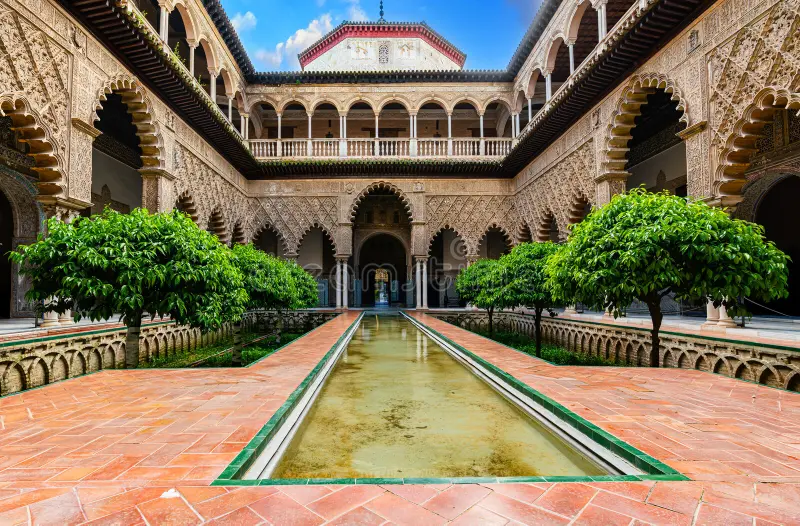
Built for King Peter I of Castile starting in 1364, this palace is considered the finest surviving example of Mudéjar architecture in Spain, with craftsmen from Granada's Nasrid court brought in to execute its plasterwork. Its Patio de las Doncellas features a sunken reflecting pool only rediscovered during 2002-05 excavations, after centuries buried beneath a Renaissance-era upper gallery.

Patio de las Doncellas

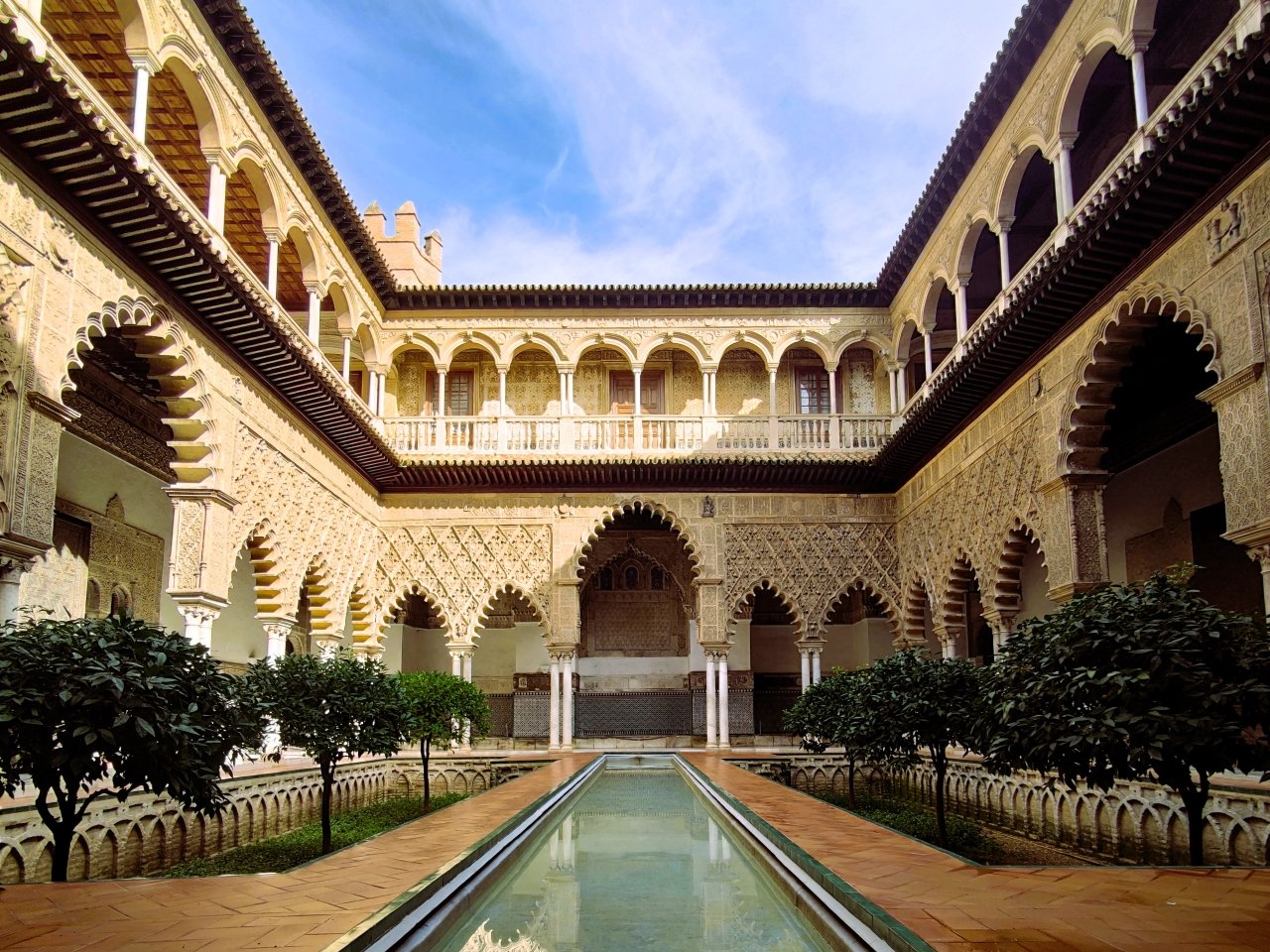
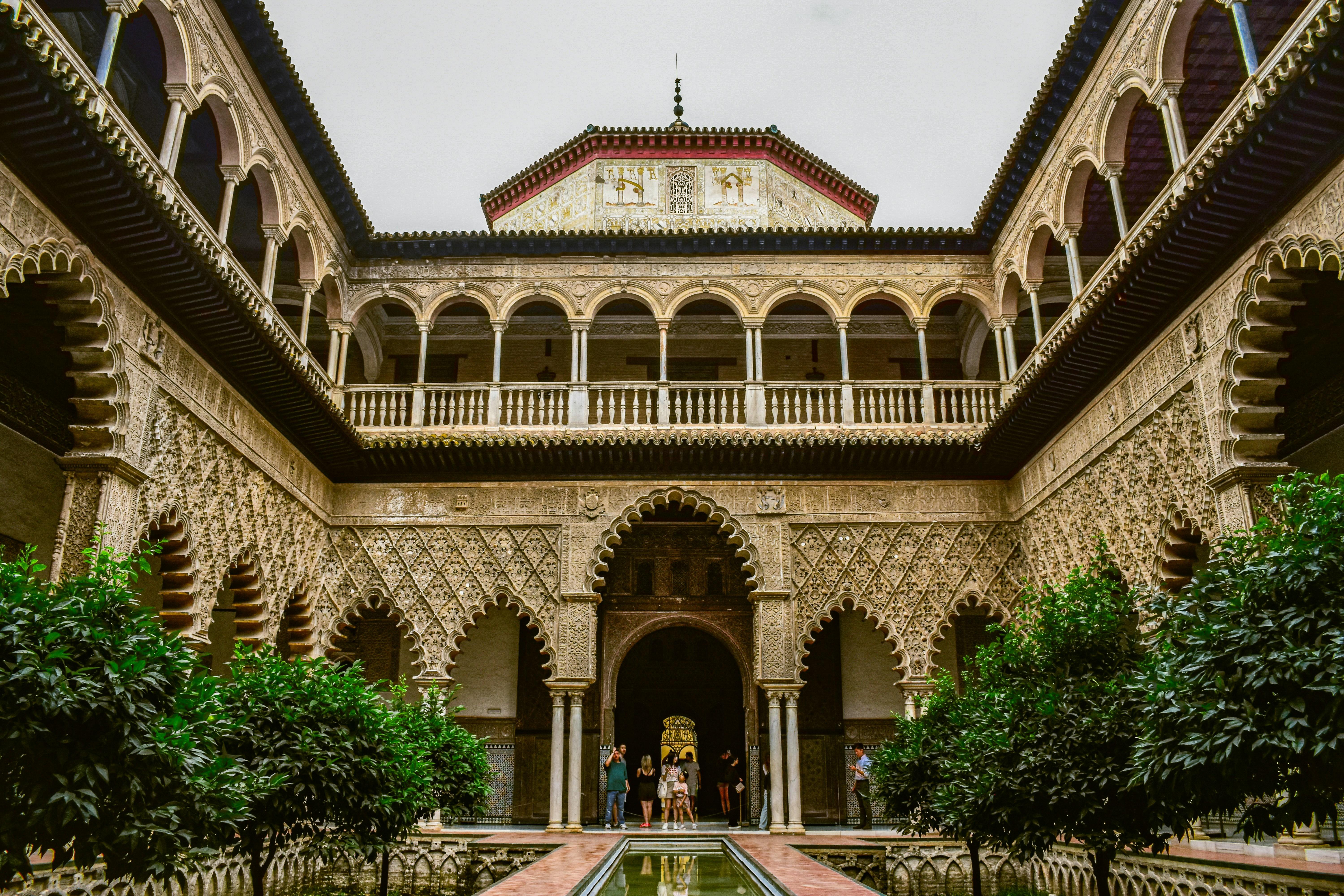
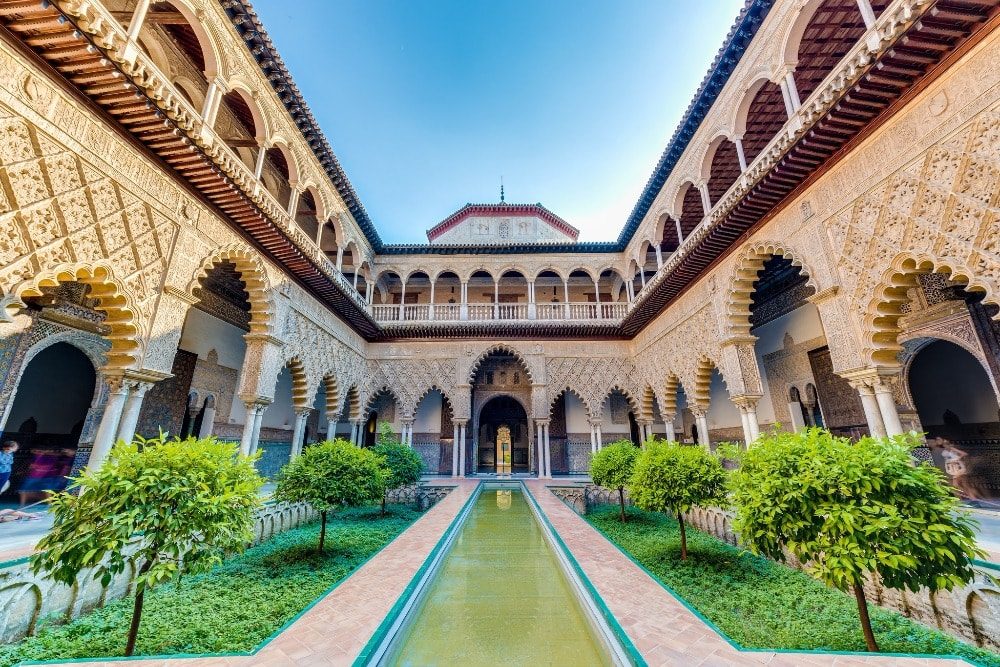
Named the Patio of the Maidens after a medieval legend involving an annual tribute of 100 virgins, this rectangular courtyard is lined with polychrome tilework and a sunken pool measuring roughly 40 meters long. Its lower arcade dates to Pedro I's 14th-century reign, while the upper gallery was added roughly two centuries later under Charles V.

Salón de Embajadores

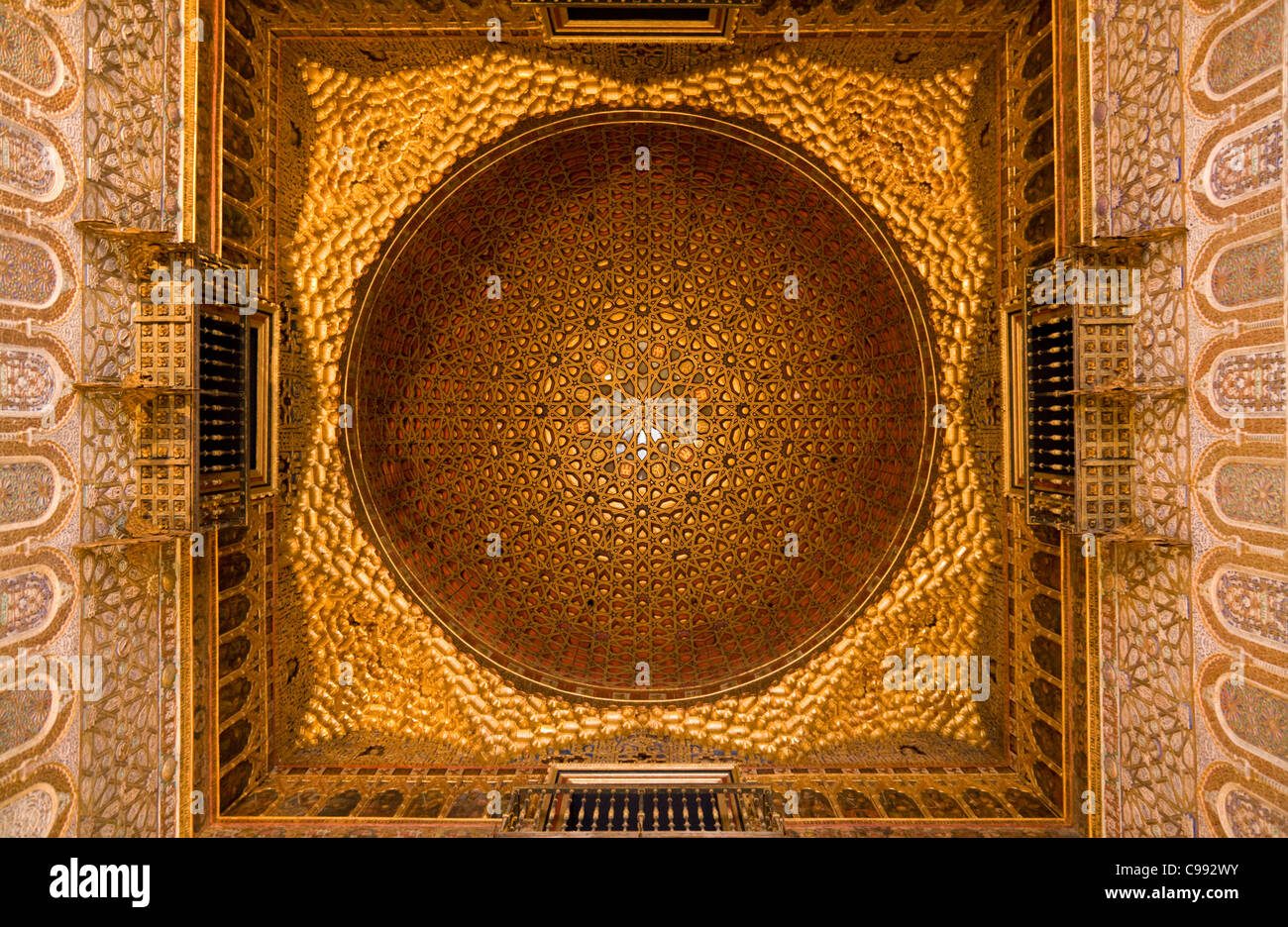
The Hall of Ambassadors is capped by a wooden dome added around 1427, composed of thousands of interlocking gilded pieces meant to evoke a starry night sky. This domed reception hall was the ceremonial heart of the palace, used historically to receive foreign dignitaries beneath horseshoe arches inherited from earlier Almohad-era construction.

Patio de las Muñecas

Known as the Patio of the Dolls for two tiny carved faces hidden in one of its column capitals, this intimate courtyard was the private residential heart of the palace complex. Its upper story of slender columns was added in the 19th century, replacing an earlier structure that had deteriorated over roughly five centuries.

Gardens of the Alcázar

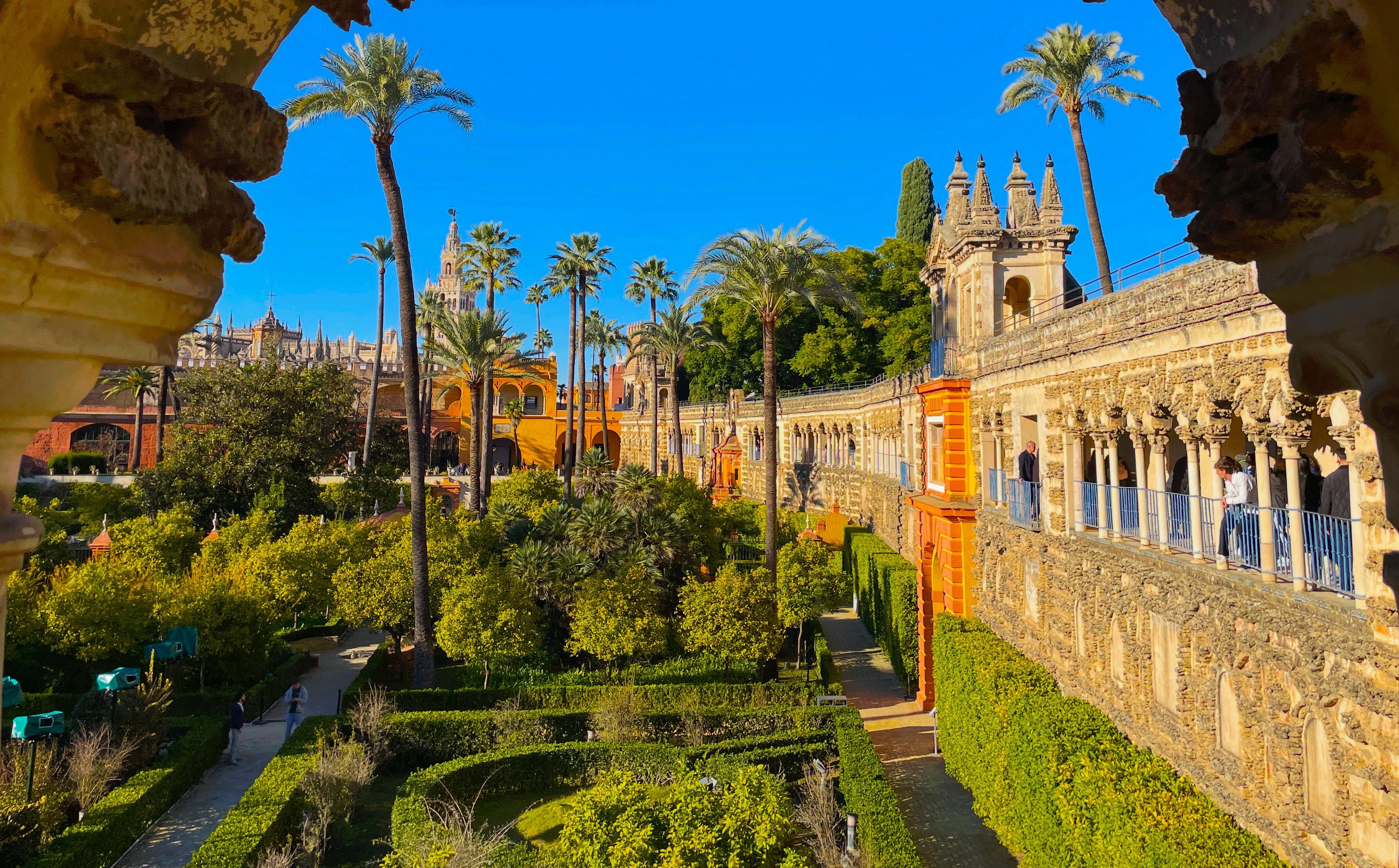
Spanning roughly seven hectares, the gardens blend Moorish, Renaissance, and later English landscaping styles across dozens of distinct sections developed over more than 500 years. The Baths of Lady María de Padilla, a rainwater cistern beneath the Patio del Crucero, take their name from the 14th-century mistress of King Pedro I.

Cuarto Real Alto

The Upper Royal Apartments remain in occasional use by the Spanish royal family today, making the Alcázar one of the only medieval palaces in Europe still serving an active royal function after roughly 700 years. Access requires a separate, timed ticket limited to small groups, distinct from general admission.

The experience

What the visit is really like

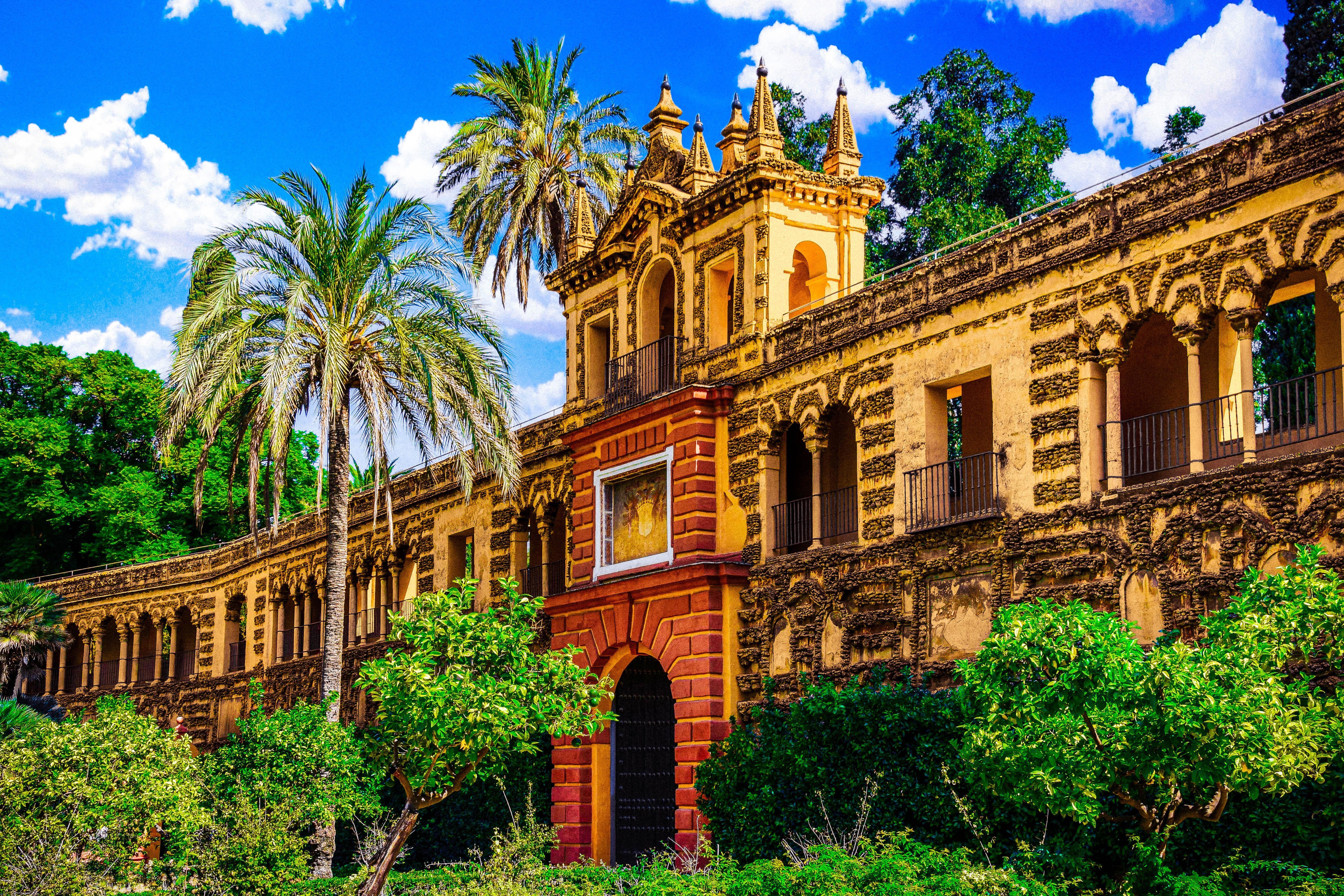
You enter through the Puerta del León, off the Patio de Banderas, and the noise of the street drops away behind the red gate. Your guide gathers the group in the Patio de la Montería, the courtyard where Pedro I once mustered his hunts, and points up at the palace façade before you step inside. You move into the Mudéjar palace and slow down. In the Patio de las Doncellas you circle the reflecting pool, watching the arches double in the water, then tilt your head back under the star-vault of the Salón de Embajadores. You run your eye along the tilework at shoulder height, tracing the geometry until the pattern repeats. A real alcazar guided tour keeps the pace deliberate here, so you catch inscriptions you would otherwise walk past. Then you cross into the gardens. You follow the water channels past orange and myrtle, climb the Galería del Grutesco for a view back over the terraces, and pause where the maze meets the pavilion of Charles V. By the time you reach the far wall, the crowds thin, and you have the shade almost to yourself.

Everything You Need to Know

Your complete experience guide

All the details about your upcoming adventure in one place

Your Real Alcazar Guided Tour Explained

A real alcazar guided tour leads you through the Mudéjar palace of Pedro I, the intricate stucco of the Patio de las Doncellas, and the sunlit tilework that defines Seville's most celebrated royal residence. Led by licensed local guides, these real alcazar guided tour tours bring context to the Almohad walls, the Salón de Embajadores, and the layered UNESCO heritage of this Seville landmark. Skip-the-line Alcázar entry means less waiting at the gate and more time among the courtyards.

The Real Alcázar of Seville is still an active royal residence — the upper floors remain reserved for the Spanish monarch, making it the oldest palace in Europe kept in continuous royal use. A real alcazar guided tour opens a compound that grew across more than a thousand years, layer settling upon layer without erasing what came before. The site began as a Muslim fortress in the tenth century, expanded under the Abbadid and Almohad dynasties, and was rebuilt after the Christian conquest of 1248. Pedro I of Castile ordered the Palacio del Rey Don Pedro in the 1360s, importing craftsmen from Granada and Toledo. The result is Mudéjar architecture at its most concentrated: a Christian king's palace built in the visual language of al-Andalus. Why the place still matters is written in its surfaces. The Patio de las Doncellas, a rectangular courtyard framed by scalloped arches and a sunken reflecting pool, sits at the palace's ceremonial heart. Above the Salón de Embajadores rises a cedar dome of interlaced gilded stars, meant to suggest the vault of heaven. Plasterwork carries Arabic and Castilian inscriptions in the same wall. Azulejo tilework runs waist-high through the chambers in geometric registers of blue, green and ochre. Beyond the palace, the gardens spread across terraces planted with orange, myrtle and cypress, threaded by water channels and the Galería del Grutesco, a raised wall pierced with grottoes. A well-led real alcazar guided tour reads these details as a continuous argument between faith, power and ornament, one that Seville has never fully resolved. Recognised as a UNESCO World Heritage Site since 1987, alongside the neighbouring Cathedral and the Archivo de Indias, the Alcázar remains one of the defining seville landmarks and a fixture of the city's Santa Cruz quarter. Its rooms have doubled as the Water Gardens of Dorne for screen audiences, drawing visitors who arrive knowing the arches before they know their history. Most real alcazar guided tour tours trace a route from the Puerta del León through the Patio de la Montería to the Mudéjar palace and out into the gardens. The compound rewards slow attention: the closer one looks at a single stucco panel, the more the boundary between decoration and inscription dissolves. It is, in the end, a building that keeps speaking in two languages at once.

A Christian king's palace built in the visual language of al-Andalus.

Dress code

There is no strict dress code for a Real Alcázar guided tour, but modest, breathable clothing is recommended given Seville's intense summer heat and the amount of walking through sun-exposed courtyards. Comfortable, flat shoes are strongly advised because several patios and the upper gallery of the Palacio del Rey Don Pedro have uneven or slick tiled flooring.

Bags & security

All visitors pass through an airport-style security check at the Puerta del León entrance, where bags are scanned and large items may be opened for inspection. Backpacks and bags larger than a standard daypack are discouraged, since there is no dedicated cloakroom or luggage storage inside the complex.

Photography

Personal photography without flash is permitted throughout the Palacios Mudéjares, the Patio de las Doncellas, and the gardens for anyone on a Real Alcázar guided tour. Tripods, monopods, selfie sticks, and commercial or drone photography require prior written authorization from the Patronato del Real Alcázar.

Families & strollers

Children of all ages are welcome on a Real Alcázar guided tour, and prams can navigate most ground-floor courtyards and the gardens without issue. Younger children generally tire in the midday heat, so a shaded rest stop in the gardens partway through is worth planning into the visit.

Accessibility

The Patio de Banderas entrance, main courtyards, and Gardens have ramp access and mostly level paths suitable for wheelchairs and pushchairs. Some upper sections, such as the Cuarto Real Alto and narrow Mudéjar archways, involve steps or thresholds that are not fully wheelchair accessible, and the historic garden paths include gravel stretches.

Food & drink

There is a small café near the gardens serving drinks, snacks, and light meals, but eating is not permitted inside the historic palace rooms themselves. Bringing a refillable water bottle is encouraged, since Seville's summer heat makes hydration important during the roughly 2-3 hour walk through open-air patios.

Not allowed

× Large backpacks × Suitcases and rolling luggage × Tripods and monopods without permit × Drones × Glass containers × Sharp objects and pocket knives × Flammable liquids × Selfie sticks in narrow galleries × Skateboards and scooters × Outside food for consumption inside palace rooms × Loudspeakers × Picnic equipment

What to bring

✓ Valid ID or passport ✓ Printed or digital ticket confirmation ✓ Refillable water bottle ✓ Sun hat ✓ Comfortable walking shoes ✓ Sunscreen ✓ Portable phone charger ✓ Light scarf or shawl for shaded rooms

Opening hours

Mon 09:30 – 19:00

Popular start of tour-group week

Tue 09:30 – 19:00
Wed 09:30 – 19:00

Mid-week, generally lighter crowds

Thu 09:30 – 19:00
Fri 09:30 – 19:00

Weekend crowds begin building

Sat 09:30 – 19:00

Busiest day of the week

Sun 09:30 – 19:00

At a glance

Hours

09:30 – 19:00 daily

Getting there

Public transport · 8-12 min walk from stop · Metro ticket around 1.35-2 EUR

Take Metro Line 1 to Puerta de Jerez station, then walk about 8 minutes through Santa Cruz to the Puerta del León entrance. Bus lines C4, C3, 5, 41, C1, and C2 also stop within a few minutes' walk.

Walk · 3-5 min · Free

From Seville Cathedral and the Giralda, it is a 3-5 minute walk across Plaza del Triunfo directly to the Alcázar's Puerta del León gate.

Car · 8-15 min walk after parking · Garage parking typically 2-3 EUR/hour

Driving into the historic center is discouraged due to narrow, pedestrianized streets; park in a paid garage near Prado de San Sebastián or Puerta de Jerez and walk the final 8-15 minutes.

Taxi · 5-10 min ride from center · Approx. 6-10 EUR within the city center

Taxis can drop passengers near Puerta de Jerez or Avenida de la Constitución, from where it's a short walk into Santa Cruz to the entrance.

Cancellation policy

Most Real Alcázar guided tour bookings can be cancelled free of charge up to 24 hours before the scheduled entry time, with a full refund of the 15.5 EUR general admission fee. Cancellations made after that window, or no-shows, are typically non-refundable since entry slots are time-stamped and limited.

Plan your time

How long do you need?

Recommended time

2-3 hours

A real alcazar guided tour typically runs 2 to 3 hours once you factor in the palace interiors and a relaxed loop through the gardens, with structured guided visits usually more efficient than wandering solo. Add 30-45 minutes if you want unhurried time among the fountains and hedges, or trim toward 2 hours if you're only hitting the main halls and courtyards. Arriving right at 09:30 opening keeps queues short, but by mid-morning tour groups stack up and the palace rooms start to feel packed. Since the site runs 09:30-19:00 daily, a late-afternoon return after the group-tour rush thins out is another way to reclaim breathing room before closing.

Crowd levels through the day

Opening rush Light
Mid-morning Heavy
Midday Peak
Early afternoon Heavy
Late afternoon Moderate
Last hour before close Light
Plan ahead

When to go — year at a glance

Weather · crowds · average price — dots go green to amber to red as each metric rises.

Spring (Mar-May)

Mild temperatures around 18-24°C and blooming gardens make March through May one of the most comfortable windows, though Easter week (Semana Santa) brings heavy crowds citywide.

Insider tips

Helpful tips for your visit

Book timed entry in advance

Real Alcázar guided tour slots for peak summer dates often sell out days ahead, so reserve online rather than risking a walk-up queue at Patio de Banderas.

Pair it with the Cathedral

Since the Alcázar sits just steps from Seville Cathedral and the Giralda, many visitors combine both in a single half-day itinerary.

Wear a hat and sunscreen

The open courtyards offer little shade during midday hours, so sun protection matters more here than at most Seville landmarks.

Carry small bills for the café

The garden café inside the complex is a convenient stop, and having cash on hand speeds up small purchases.

Budget extra time for the Cuarto Real Alto

Because this upper apartment ticket is timed separately, arrive at its designated slot rather than assuming it flows continuously from general admission.

Use the Jardines de Murillo shortcut

Visitors staying near Plaza de España can approach through the Jardines de Murillo path, avoiding the busiest Santa Cruz lanes.

Check for room closures

Restoration work occasionally closes specific palace rooms without notice, so it's worth checking the official site the morning of your visit.

Where to meet

Meeting points

Puerta del León

Patio de Banderas s/n, 41004 Sevilla, Spain

Main entrance gate; most Real Alcázar guided tour groups gather here before security

Get directions

Plaza del Triunfo

Plaza del Triunfo, 41004 Sevilla, Spain

Small square opposite the Archivo de Indias, common alternate meeting spot for combined cathedral-Alcázar tours

Get directions
The story

The history behind the site

The story begins in 913, when the Umayyad emir Abd al-Rahman III ordered a fortified enclosure raised on the ruins of a Roman and Visigothic settlement beside the Guadalquivir. This first citadel guarded the young city of Seville. In the 11th century the Abbadid rulers expanded it. Under the Almohads, from around 1150, the compound grew into a walled palatine city, and the Patio del Yeso survives from that period. A real alcazar guided tour today still traces these overlapping foundations stone by stone. The turning point arrived after the Christian conquest of 1248. Ferdinand III took the fortress; his son Alfonso X later built a Gothic hall within its walls. The defining transformation, however, belongs to Pedro I of Castile. Between 1364 and 1366 he commissioned the Palacio Mudéjar, employing craftsmen from Granada and Toledo. Their carved plaster, azulejo tilework, and coffered ceilings fused Islamic and Castilian forms. Many real alcazar guided tour tours center on the Patio de las Doncellas at the palace's heart. Later centuries added their own layers. Charles V, whose 1526 marriage to Isabella of Portugal was celebrated here, ordered Renaissance apartments and a chapel. A Sevilla royal palace tour reveals how each dynasty wrote over the last without erasing it. The Casa de Contratación, founded in 1503, made the Alcázar the administrative heart of Spanish exploration of the Americas. The monument was named a UNESCO World Heritage Site in 1987, recognized as the oldest royal palace in Europe still in active use. The Spanish royal family retains the upper Cuarto Real Alto as an official residence. A real alcazar guided tour tour of these rooms shows a living building rather than a museum. Those seeking real alcazar guided tour tickets encounter eleven centuries compressed within one continuous set of walls, a rare example of Mudéjar architecture preserved through unbroken royal occupation.

913

Abd al-Rahman III orders the first Umayyad fortress beside the Guadalquivir.

c.1150

Almohad rulers expand the site into a walled palatine city.

1248

Ferdinand III takes the fortress after the Christian conquest of Seville.

1364–66

Pedro I builds the Mudéjar Palace with craftsmen from Granada and Toledo.

1503

The Casa de Contratación is founded, governing trade with the Americas.

1526

Charles V marries Isabella of Portugal and adds Renaissance apartments.

1987

UNESCO designates the Alcázar a World Heritage Site.

Photo spots

Best photo spots

Hall of Ambassadors

Best light · Late morning for even light on the plasterwork

The gilded dome above the throne room is the signature shot, best framed low through the horseshoe arches from the Hall of the Ambassadors' entrance; tripods aren't permitted, so rest a phone or camera on the floor and use the self-timer for a sharp low-ISO capture. Many first-time visitors booking a real alcazar guided tour list this ceiling as the single image they came for.

Mercury's Pond

Best light · Early morning before wind ripples the water

A long reflecting pool topped by a bronze Mercury statue, shot from the raised balustrade so the water mirrors the Gallery of the Grotesque behind it. It's one of the most recognizable Seville landmarks from Game of Thrones filming and photographs best when the pool surface is still.

Baths of María de Padilla

Best light · Midday light filtering through the vaults

A sunken, barrel-vaulted cistern beneath the Patio del Crucero, its arches doubling in the still water below; stand at the top of the entry stairs for the classic symmetrical reflection shot. Reached via the Jardín de la Danza, it stays cool and dim even in summer.

Jardín de la Danza

Best light · Shortly after opening

A quiet Renaissance garden between the Gothic Palace and Casa de la Contratación, with geometric hedges, tiled benches, and fountains framing views toward the baths entrance below. Good for wide architectural shots with fewer crowds than the main courtyards.

Gallery

Moments from the experience

With kids

Visiting with kids

A real alcazar guided tour works well for families, since the gardens and main palace rooms give kids room to roam while the historic surfaces demand some flexibility with gear. Children generally enjoy the Sevilla Alcázar tour once they're primed to spot dragon-eggs-worthy details, so a little storytelling beforehand goes a long way.

Strollers

Gardens and the main patios take a stroller fine, but steps and uneven stone around the Baths of María de Padilla and the upper walkways make a lightweight, foldable model or a carrier much easier.

Best ages

Kids around 6 and up tend to engage best, since the site rewards imagination over passive looking; toddlers do fine in the gardens but tire quickly on the palace's stone floors.

Facilities

Accessible toilets with baby-change are near the Puerta del León entrance and in the gardens, though signage inside is limited, so grab a map at the ticket counter.

Pacing

Plan for slow stretches indoors and a longer pause in the gardens; young children nap better if you time the palace rooms first and save open-air wandering for when energy dips.

Game of Thrones angle

Telling older kids that parts of the grounds doubled as Dorne on the real alcazar guided tour tours turns courtyards into a scavenger hunt instead of just old rooms.

Rainy-day plan

Garden sections can close during weather alerts, so keep the indoor Mudéjar rooms as the backup focus if skies turn on the day of your visit.

Customer Reviews

What travelers say

Real experiences from real travelers

4.6
Based on undefined reviews
1 ★ 520
2 ★ 410
3 ★ 940
4 ★ 3210
5 ★ 14820
M
Marta L.
Spain · 2026-06-18

Worth the early slot

We booked the first morning entry and the Patio de las Doncellas was almost empty for twenty minutes. Our guide explained the layers of Almohad and Mudéjar work in plain language, which made the ceilings mean something. The real alcazar guided tour moved at a comfortable pace and never felt rushed.

J
James R.
United States · 2026-05-02

Guide made it click

I would have wandered past half the rooms without understanding them. The Ambassadors Hall ceiling and the tilework in the Doncellas courtyard came alive once someone pointed out the details. Solid Seville Alcázar tour, and the palm-shaded gardens at the end were a nice cooldown.

K
Kenji T.
Japan · 2026-07-11

Hot but manageable

July heat was intense by midday so bring water and a hat. The Baños de Doña María de Padilla underneath stayed cool and the reflections were lovely. Our real alcazar guided tour tickets included headsets, which helped in the busier halls.

S
Sophie M.
France · 2026-03-27

Mudéjar magic

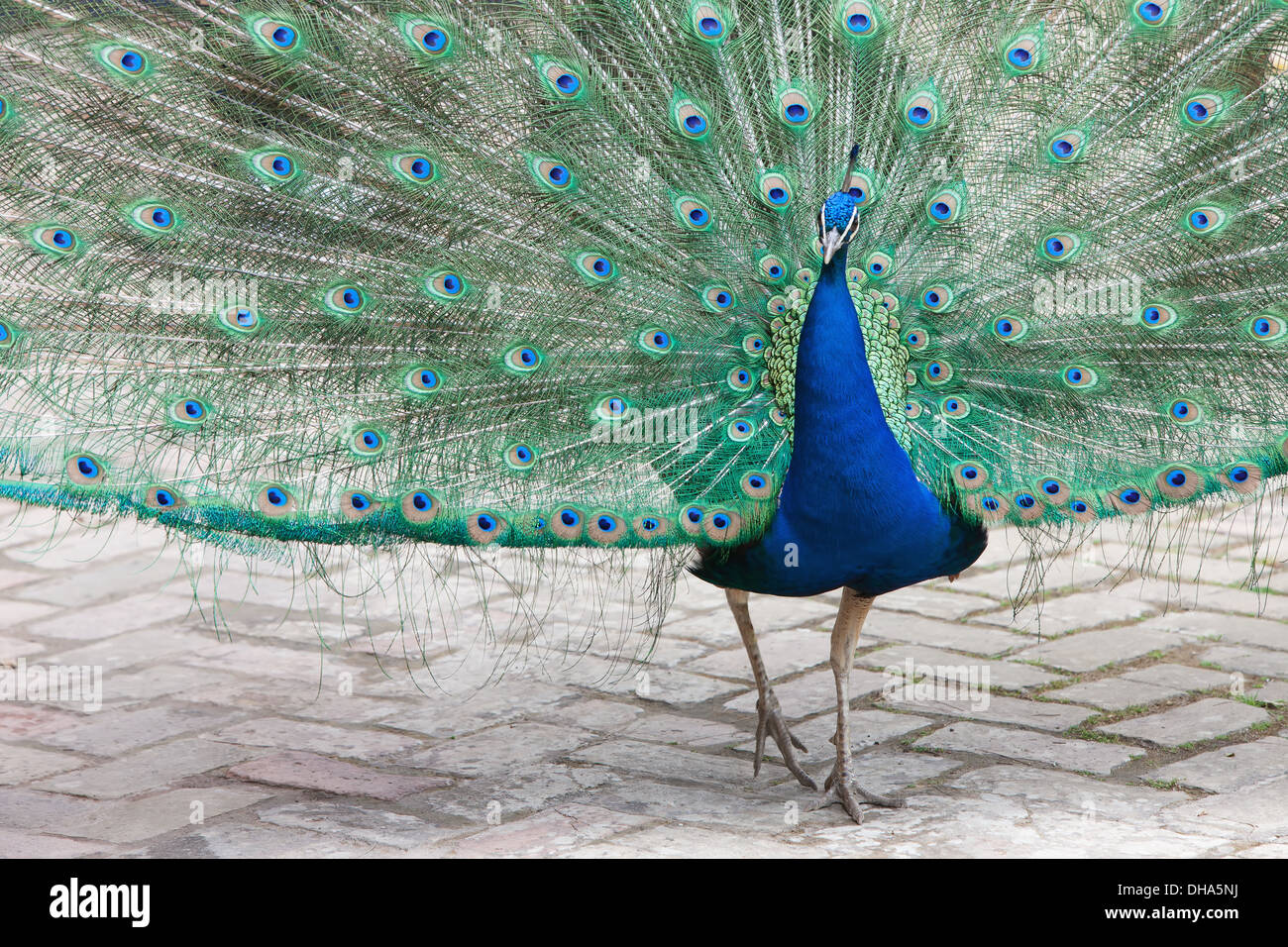
The sebka latticework and horseshoe arches are the reason to come, and the gardens surprised me with orange trees and a wandering peacock. A guide is genuinely useful here to separate the Christian and Islamic building phases. One of the more rewarding Seville landmarks I visited.

A
Andreas K.
Germany · 2026-04-14

Skip the queue

Buying skip-the-line Alcázar entry saved us close to an hour in the spring sun. Small group, clear narration, and the guide adjusted when a school party crowded a room. The real alcazar guided tour tour ended with free time to explore the upper royal quarters.

L
Lucia F.
Italy · 2025-11-09

Autumn light was perfect

Late afternoon in November meant soft light across the Grutescos gallery and hardly any crowds in the gardens. The stucco in the Ambassadors Hall glowed. I appreciated how the visita guiada Real Alcázar covered the filming history without dwelling too long on it.

P
Priya S.
United Kingdom · 2026-06-30

Detailed and unhurried

Our guide clearly loved the place and it showed in the small asides about the reflecting pool and the tile patterns. The real alcazar guided tour tours run in several languages, which made booking easy for our mixed group. Cool tiled interiors were a relief from the Seville heat.

C
Carlos B.
Brazil · 2025-09-22

Good but book ahead

Even in late September the standard queue was long, so pre-booked entry is the way to go. The courtyards and the sunken bath gallery were the highlights for me. A knowledgeable guide turns a pretty building into a real story of the city.

E
Emma W.
Australia · 2026-02-15

Layers of history

Standing in the Patio de las Doncellas at opening, with light just reaching the arches, was quiet and calm. The guide walked us through the Almohad foundations up to the later royal additions without losing anyone. This Real Alcázar walking tour is easily among the best experiences in Seville.

T
Tomás H.
Mexico · 2026-01-28

Gardens stole the show

I came for the palace and left obsessed with the gardens, the hedges, fountains, and that Grutescos wall in winter light. The guide's timing meant we hit the busiest halls before the tour groups arrived. Clear, well paced, and the reflecting pool photo was worth the trip alone.

FAQ

Frequently asked questions

Everything you need to know for your journey

Around the corner

Nearby landmarks worth a detour

Seville Cathedral

3-5 min walk

church

The world's largest Gothic cathedral, built from 1401 on the site of a former mosque, with the Giralda bell tower rising alongside it.

Giralda Tower

3-5 min walk

landmark

A 104-meter Moorish minaret-turned-bell-tower, climbed via a ramped interior corridor originally designed for horses rather than stairs.

Barrio Santa Cruz

2-3 min walk

square

The former Jewish quarter of Seville, a maze of narrow whitewashed streets, orange-tree courtyards, and small plazas like Plaza de Doña Elvira.

General Archive of the Indies

3-5 min walk

museum

A 16th-century former merchants' exchange that now houses colonial-era documents and maps, standing directly beside the cathedral.

Torre del Oro

8-10 min walk

landmark

A 13th-century riverside watchtower on the Guadalquivir, historically used to control access to the port.

Plaza de España

10-12 min walk

square

A grand semicircular plaza built for the 1929 Ibero-American Exposition, with a tiled canal and alcoves representing Spanish provinces.

Where to stay

Where to stay nearby

Santa Cruz district

2-8 min walk

district

The historic quarter immediately surrounding the Alcázar, packed with boutique hotels and guesthouses in converted townhouses.

EME Catedral Hotel

4-6 min walk

luxury

A design hotel facing the cathedral with a rooftop terrace overlooking the Giralda and Alcázar walls.

Hotel Casa 1800 Sevilla

5-7 min walk

boutique

A converted 19th-century mansion in Santa Cruz with a courtyard patio and rooftop plunge pool.

Arenal district

10-12 min walk

mid-range

A central riverside neighborhood near Torre del Oro with a wide range of mid-range hotels and easy tram access.

Ready for Adventure?

Join thousands of happy travelers who have discovered this incredible experience

Book Your Experience Now